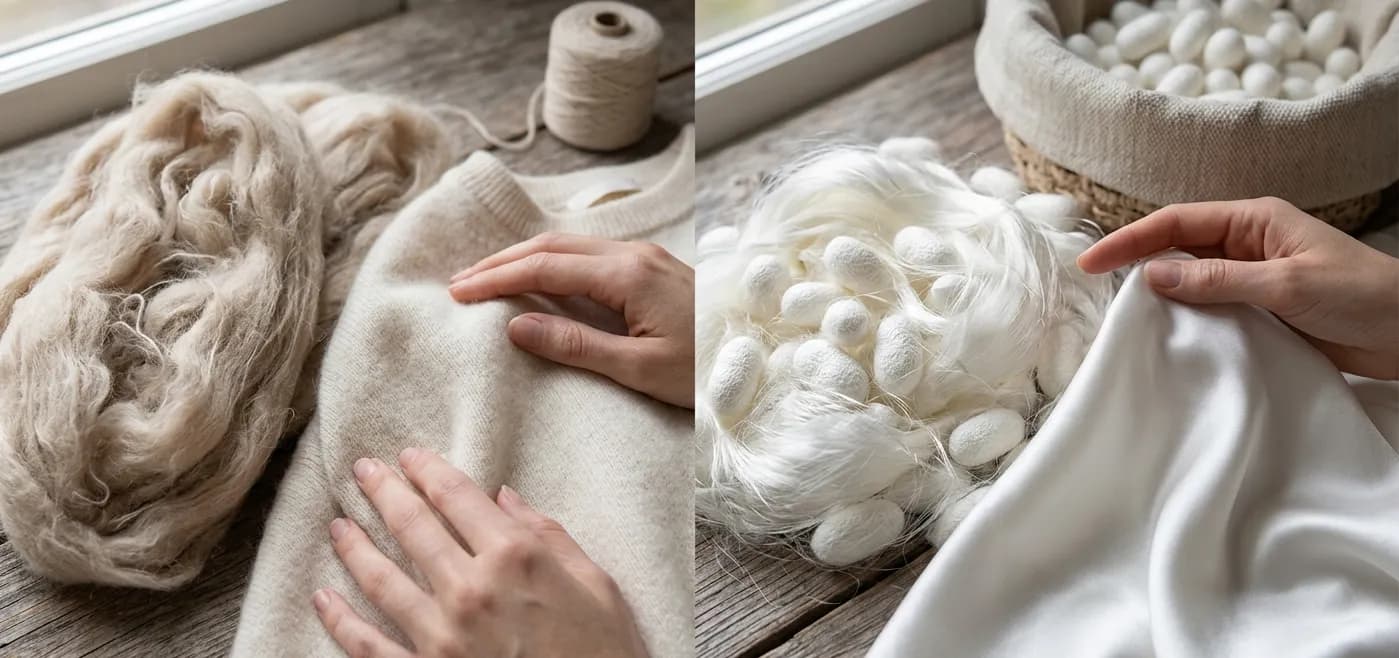
Where They Come From
Cashmere comes from the soft undercoat of cashmere goats, which live primarily in Mongolia, China, Afghanistan, and parts of Iran. Each spring, herders comb the fine undercoat from the goats by hand during the moulting season. A single goat produces only around 100 to 200 grams of usable fibre per year, which means one sweater typically requires the annual yield of two to five goats.
Silk comes from silkworms, specifically the cocoons spun by the larvae of the Bombyx mori moth. Each cocoon is made from a single continuous thread of raw silk that can be anywhere from 300 to 900 metres long. To harvest the silk, the cocoons are placed in hot water to soften them, and the threads are carefully unwound and twisted together to form yarn. This process, known as reeling, is highly skilled and labour-intensive.
Both fibres have been prized for millennia. Cashmere was traded along the Silk Road from Central Asia. Silk was so valuable in ancient China that the methods for producing it were kept secret for centuries.
How They Feel
This is the most immediate and noticeable difference between the two fibres. Cashmere feels soft, warm, and cosy. It has a natural loft and depth to it that makes it feel substantial despite being lightweight. High quality cashmere has an almost cushioned quality, like the fabric is gently hugging you rather than simply covering you.
Silk feels smooth, cool, and lustrous. Where cashmere has warmth, silk has a gliding quality that feels almost liquid against the skin. Silk is celebrated for its natural sheen, which gives it a visual quality unlike any other fibre. It drapes beautifully and moves with the body in a way that cashmere does not.
Warmth and Temperature Regulation
Cashmere is a warm fibre. The hollow structure of the cashmere fibres traps warm air and provides excellent insulation. A thin cashmere layer provides significantly more warmth than most other fabrics of the same weight.
Silk is a temperature-regulating fibre rather than a warm one. In cold conditions, silk traps a thin layer of warm air against the skin, providing light insulation. In warm conditions, silk allows heat to escape and keeps the wearer cool and comfortable.
Breathability
Silk is highly breathable and excels at moisture management. It can absorb up to 30 percent of its own weight in moisture before feeling damp, and it wicks moisture away from the skin efficiently. This is why silk feels cool and dry even in warmer conditions.
Cashmere breathes well in cool conditions and regulates temperature effectively, but it is not designed for warm weather or for situations involving perspiration. In warm conditions cashmere can feel heavy and retain heat uncomfortably.
Durability and Longevity
Silk is surprisingly strong for such a delicate-feeling fabric. A single silk thread has a tensile strength comparable to a steel filament of the same diameter. Silk garments, when properly cared for, can last for decades. However, silk is vulnerable to prolonged exposure to sunlight and can snag or tear on rough surfaces.
Cashmere is more delicate in everyday handling but more resilient in other ways. It is prone to pilling, especially lower grade cashmere, but does not snag as easily as silk. High quality cashmere that is washed and stored correctly actually improves with age, becoming softer and more beautiful over many years of wear.
Care and Washing
Both cashmere and silk require more careful handling than everyday fabrics, though in slightly different ways. Both need cool water. Neither should go near a tumble dryer.
| Care area | Cashmere | Silk |
|---|---|---|
| Washing | Hand wash in cool water or use a very delicate machine cycle | Hand wash in cool water or use specialist silk wash; some items dry clean only |
| Drying | Lay flat; never hang or tumble dry | Dry away from direct sunlight; lay flat or hang carefully depending on garment |
| Storage | Folded, with moth protection | Keep away from sunlight and avoid creasing where possible |
| Ironing | Generally avoid direct heat and press only with care | Can be ironed on low while slightly damp, with a pressing cloth |
Appearance and Drape
Cashmere has a matte finish with a soft, slightly hazy surface quality. It looks understated and quiet. Cashmere knitwear has a texture and depth to it that photographs beautifully but does not demand attention in the way a shiny fabric does.
Silk has a natural lustre that makes it visually distinctive from almost any other fabric. The sheen comes from the triangular cross-section of the silk fibre, which reflects light in a similar way to a prism. Silk garments have an inherent elegance and dressiness that cashmere does not have in the same way.
Price and Value
Cashmere garments from reputable brands typically start at around 150 pounds or dollars for a sweater and can reach several hundred for a high-quality piece from a heritage brand. Silk pricing varies more widely depending on the type of silk, the weight of the fabric, and the garment construction.
In terms of long-term value, well-cared-for pieces of both fibres can last decades. The cost per wear over time makes both a reasonable investment compared to faster fashion alternatives.
Sustainability
Cashmere has a well-documented sustainability challenge. The global demand for cheap cashmere has led to massive increases in goat herding in parts of Mongolia and China, which has caused significant overgrazing and land degradation. Responsible cashmere brands work with certified sustainable herding programmes and transparent supply chains to address this.
Silk production has its own ethical complexity. Conventional silk harvesting requires boiling the cocoons while the pupae are still inside. Ahimsa silk, also called peace silk or cruelty-free silk, is produced by allowing the moth to emerge from the cocoon naturally before the silk is collected.
What Each Fabric Does Best
Cashmere excels at warmth, softness, and cold-weather comfort. It is the fibre to choose when you want something that feels like the softest, warmest version of knitwear imaginable. It works best in autumn and winter and for pieces you plan to invest in and wear for many years.
Silk excels at elegance, drape, and versatility across seasons. It is the fibre to choose when you want something that looks refined and moves beautifully, that works for warm weather as well as cool, and that brings a visual quality to an outfit that cashmere does not.
Cashmere and Silk Blends
It is worth knowing that cashmere and silk are sometimes blended together, and the result is one of the most beautiful fabric combinations available. A cashmere-silk blend brings together the warmth and softness of cashmere with the smoothness and lustre of silk. The silk content makes the garment more fluid in its drape and gives it a slight sheen that pure cashmere does not have.
Cashmere-silk blends are often used for lightweight knitwear, scarves, and wraps where a lighter, more fluid feel is desirable. They are also easier to care for than pure cashmere in some cases because the silk content gives the yarn a little more strength.
What silk adds to cashmere: better drape, subtle sheen, lighter feel.
What cashmere adds to silk: more warmth, softer thermal comfort, less slippery handling.
Blend rule: look for a clear label stating the percentage of each fibre.
Side by Side Summary
| Dimension | Cashmere | Silk |
|---|---|---|
| Softness | Warm, plush, enveloping | Smooth, cool, frictionless |
| Warmth | High insulation | Low insulation, temperature regulating |
| Breathability | Good in cool weather | Excellent across seasons |
| Drape | Good with body | Excellent fluid drape |
| Lustre | Matte/subtle | High natural sheen |
| Durability | Prone to pilling, but long-lasting | Strong fibre, but sensitive to sunlight and snags |
| Care | Cool water, flat drying, moth protection | Cool water or dry clean, protect from sunlight |
| Seasonality | Best for autumn and winter | Works across all seasons |
Which One Should You Choose?
Choose cashmere when the weather is cold and warmth is the priority, when you want the softest possible fabric against your skin, or when you are investing in a knitwear piece you plan to wear for many years.
Choose silk when you want something elegant and fluid, when you need a fabric that works in warmer conditions as well as cooler ones, or when appearance and drape are more important than insulation.
Choose a cashmere-silk blend when you want the best qualities of both in a single lightweight and versatile garment.
Frequently Asked Questions
The Bottom Line
Cashmere and silk are both exceptional luxury fibres, but they excel at different things. Cashmere is about warmth, softness, and cold-weather comfort. Silk is about drape, sheen, and seasonal versatility.
Most people who love quality fabrics end up with both because they solve different problems beautifully. The right choice depends on what you want the garment to do.