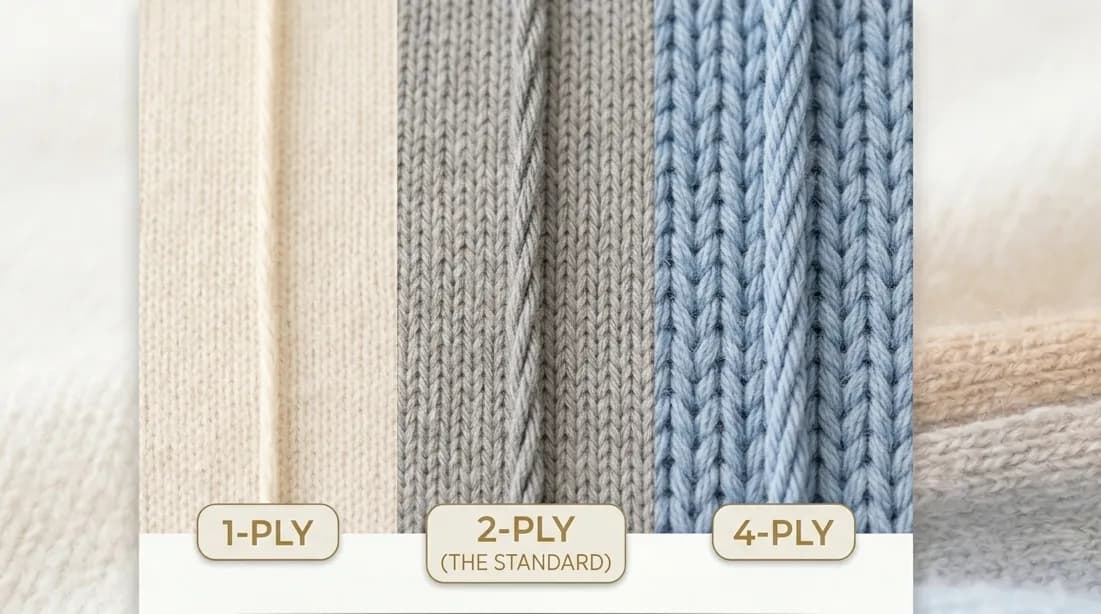
Cashmere Ply Guide: 1-Ply vs 2-Ply vs 4-Ply Explained
Learn what cashmere ply really means, from 1-ply to 4-ply and beyond. Understand warmth, weight, durability, and how to choose the best cashmere for your needs.
Cashmere Ply Guide
1-Ply, 2-Ply, 4-Ply and Beyond: What the Numbers Actually Mean
Ply is a construction term, not a quality grade. It tells you how many yarn strands are twisted together, not how fine the cashmere fiber is.
When a label says 2-ply or 4-ply, it is describing yarn construction. It does not directly tell you softness, fiber grade, or luxury level. Once you separate ply from fiber quality, cashmere labels become much easier to read.
What Ply Actually Means
Ply is the number of spun single yarn strands twisted together to make the final yarn.
- 1-ply: one single strand
- 2-ply: two strands twisted together
- 4-ply: four strands twisted together
Plying improves yarn stability and strength. It also changes garment weight, warmth, drape, and structure.
What ply does not tell you:
- Fiber micron quality
- Fiber grade (A/B/C)
- True softness level on skin
Core Distinction
- Ply = yarn construction
- Fiber grade = raw cashmere quality
- A higher ply count does not mean better fiber
How Cashmere Yarn Is Made and Plied
Cashmere fiber is collected, sorted, cleaned, and dehaired before spinning. Spinning creates singles (single yarn strands). Plying then twists two or more singles together, usually in the opposite direction to balance the yarn.
Balanced plied yarn is usually:
- More stable
- Less prone to twisting/kinking
- Better at holding stitch definition
Important: fiber fineness is decided before plying. Plying cannot convert low-grade cashmere into high-grade cashmere.
1-Ply Cashmere: Lightest Construction
1-ply is very light and drapey, ideal for layering and mild weather.
Best uses:
- Lightweight layering under jackets
- Mild climates
- Travel packing
Watch-outs:
- More prone to pilling and snagging
- Less forgiving in washing
- Quality depends heavily on fiber grade
2-Ply Cashmere: The Everyday Standard
2-ply is the most common construction because it balances comfort, durability, and versatility.
Best uses:
- Year-round sweaters and cardigans
- Office and smart-casual wear
- First cashmere purchase
- Gift buying
Watch-outs:
- Huge quality variation in market
- 2-ply label alone is not enough; check feel and build
4-Ply Cashmere: Winter Weight and Structure
4-ply is thicker, warmer, and more structured. It works best for cold weather and statement knitwear.
Best uses:
- Winter coats and heavy cardigans
- Chunky knits
- Textured/cable styles
Watch-outs:
- Too warm for many indoor settings
- Heavier and less layer-friendly
- Needs careful flat drying after washing
Beyond 4-Ply: 6-Ply, 8-Ply and Chunky Styles
Higher ply counts are less common in everyday garments. They are mostly seen in very heavy knits, extreme-cold pieces, and blankets.
Some chunky pieces use roving-style construction instead of traditional plied yarn. These can feel very soft but are often more fragile and pill faster.
Ply at a Glance
| Ply | Weight | Warmth | Best for | Watch out for |
|---|---|---|---|---|
| 1-ply | Very light | Low to moderate | Layering, warm climates, travel | Fragility, faster pilling |
| 2-ply | Medium | Moderate to warm | Everyday wear | Quality varies widely |
| 4-ply | Substantial | Very warm | Winter outerwear, cold climates | Heavy feel, less versatile |
| 6-ply+ | Heavy | Maximum | Extreme cold, statement knits | Rare, quality control matters |
Ply vs Fiber Grade
Ply and grade are separate variables.
| Factor | Ply | Fiber Grade |
|---|---|---|
| What it measures | Number of yarn strands | Fiber fineness/quality |
| Effect on softness | Indirect | Direct |
| Effect on warmth | Direct | Secondary |
| Effect on durability | Moderate | Significant |
| Usually listed on label | Often | Rarely |
In practice, high-grade 2-ply can outperform low-grade 4-ply for softness, longevity, and daily wear satisfaction.
What Ply Is Best for You?
| Need | Recommended ply | Why |
|---|---|---|
| Lightweight layering | 1-ply or fine 2-ply | Low bulk, easy layering |
| Everyday sweater | 2-ply | Most versatile balance |
| Office/smart-casual | 2-ply | Clean drape and structure |
| Winter outerwear knit | 4-ply | Better warmth and body |
| Statement knit | 4-ply or 6-ply | Texture and visible substance |
| Warm climate wear | 1-ply | Comfort in mild temperatures |
Reading Labels Better
When ply is listed, use it for function (weight and warmth), not as quality proof.
When ply is not listed, assess:
- Weight and drape
- Stitch fullness
- Brand transparency
- Feel on sensitive skin (inner wrist)
Terms to interpret carefully:
- "Extra fine cashmere" = usually fiber fineness, not ply
- "Double knit" = knit method, not necessarily 2-ply
- "Chunky" = visual weight only; construction can differ
Final Takeaways
- Ply tells you yarn construction, not raw fiber quality.
- Fiber grade and ply must be evaluated together.
- 2-ply is the most practical default for most buyers.
- Use 1-ply for light layering, 4-ply for true winter weight.
For comparison shopping, read How to Spot Fake Cashmere and Cashmere vs Merino Wool.