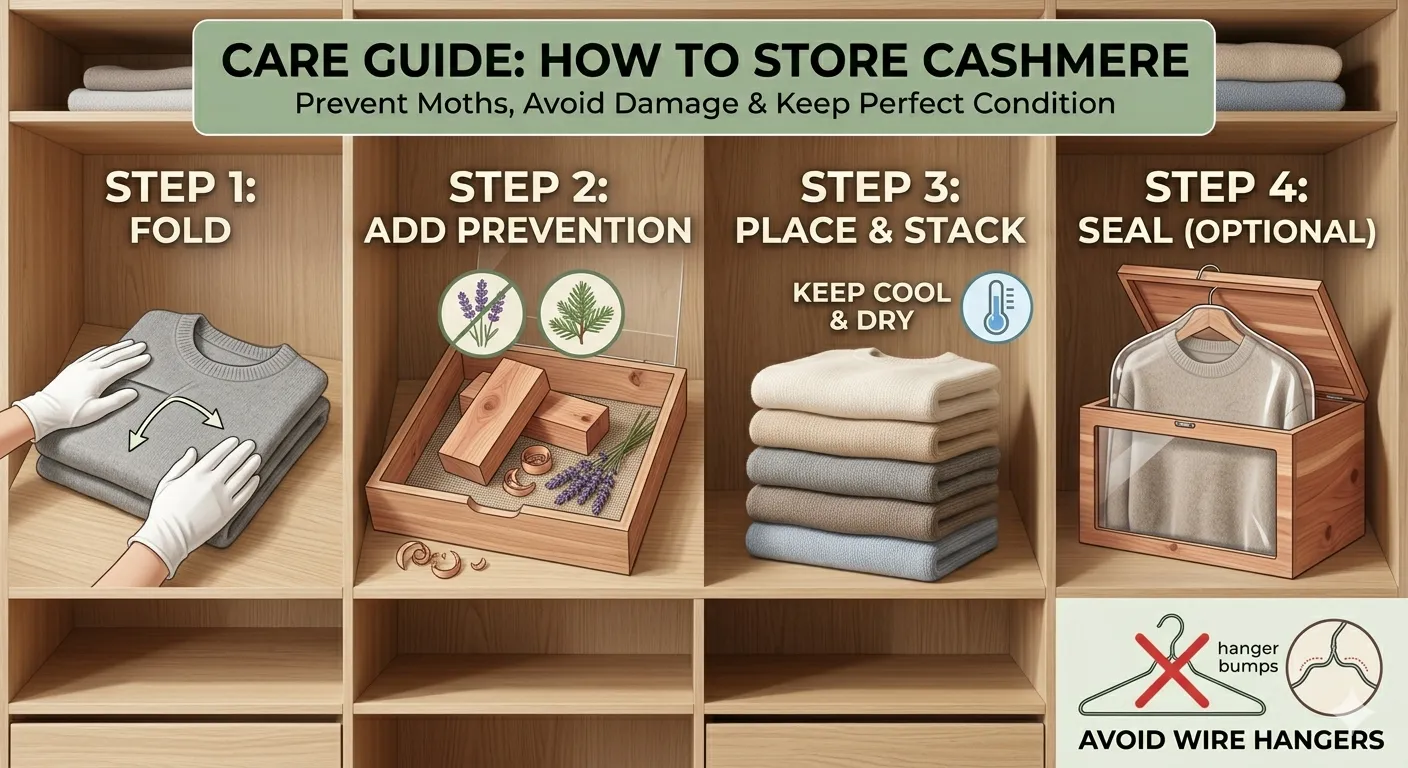
How to Store Cashmere Properly | Prevent Moths & Keep Shape
Learn how to store cashmere the right way. Prevent moth damage, avoid stretching, and keep your sweaters in perfect condition with expert storage tips.
How to Store Cashmere
Prevent moths, avoid damage, and keep every piece in perfect condition.
Most cashmere damage happens not during wear, but during storage. A sweater can be washed correctly and handled gently, then still be ruined by months in the wrong environment.
This guide covers the full storage system: prep before storage, folding vs hanging, moth prevention, container choice, in-season rotation, and recovery steps if damage appears.
Why Storage Is Where Most Cashmere Gets Damaged
Cashmere is a protein fiber. It performs well in normal wear, but storage introduces specific risks that are easy to miss.
The Three Threats to Stored Cashmere
- Physical distortion from hanging
- Moth damage from larvae feeding on keratin
- Humidity and compression that flatten loft and encourage mildew
Physical distortion is caused by gravity pulling on knit loops over time. Moth damage is biological and often discovered late. Humidity and over-compression reduce softness and shape recovery.
Before You Store: Always Wash First
Always wash cashmere before long-term storage, even if it looks clean.
Moths are attracted to organic residue: body oils, skin cells, perspiration, and food traces. A "clean-looking" sweater can still be highly attractive to larvae over a six-month storage period.
Pre-Storage Preparation Checklist
- Wash with a cashmere-safe method and detergent.
- Rinse thoroughly.
- Dry fully, flat, and completely.
- Air at room temperature for a few additional hours.
- Inspect for holes, weak spots, and signs of infestation.
Why This Step Is Non-Negotiable
- Organic residue feeds moth larvae
- Invisible soiling is enough to trigger infestation
- Seasonal storage duration allows full moth lifecycle development
Folding vs Hanging: Not a Grey Area
Cashmere should be folded for storage. Never hung.
Knits are loop-based and elastic. Long-term hanging creates shoulder points, sleeve elongation, and body drop from continuous gravity load.
| Fold for storage | Never hang cashmere |
|---|---|
| Preserves knit structure and dimensions | Causes shoulder bumps and stretching |
| Prevents sleeve/body elongation | Distortion increases over time |
| Better space efficiency in boxes/drawers | No hanger fully eliminates gravity stress |
| Correct for all cashmere knitwear | Often difficult to reverse once set |
How to Fold Cashmere Correctly
- Lay garment flat and smooth gently.
- Fold sleeves across the back.
- Fold lengthwise to reduce width.
- Fold from hem upward in halves or thirds.
- Place fold side down in stack.
- Keep stack height moderate (around 3 to 4 pieces max).
Understanding Clothes Moths
Adult clothes moths do not eat the garment. Larvae do.
Larvae feed on keratin in cashmere and wool, especially in warm, dark, undisturbed storage with organic residue present.
Conditions Moths Need
- Warmth
- Darkness
- Low disturbance
- Food source (soiled fibers)
Moth prevention works by removing these conditions as much as possible.
Moth Prevention: What Works and What Does Not
| Method | Effectiveness | Safe for cashmere | Notes |
|---|---|---|---|
| Airtight sealed container | Excellent | Yes | Best off-season baseline |
| Fresh cedar blocks/balls | Good | Yes | Must remain fragrant; refresh yearly |
| Fresh lavender sachets | Good | Yes | Replace when scent fades |
| Freezer treatment (-18C, 72h+) | Excellent kill method | Yes | Kills eggs, larvae, pupae, adults |
| Regular disturbance and airing | Good | Yes | Strong in-season method |
| Mothballs (naphthalene) | Effective but toxic | No | Not recommended for fine knitwear |
| Spent cedar/lavender | None | Yes | No scent means no active deterrence |
Best Storage Containers for Cashmere
Airtight zip storage bags
Best for long-term storage. Seal well, but avoid extreme vacuum compression that crushes fiber loft.
Breathable cotton/linen bags
Useful for short-term and easy access. Better airflow, but less protection than sealed storage.
Lidded storage boxes
Excellent for folded stacks. Add fresh cedar/lavender. Acid-free boxes are best for premium pieces.
Drawers and shelves
Good for in-season storage only, when garments are handled regularly.
Avoid These
- Standard non-archival cardboard for long-term storage
- Generic plastic bags that trap moisture
- Any long-term hanging setup
- Storage near radiators, heated floors, or direct sun
Between-Season Storage: Step-by-Step
- Inspect every piece in bright light.
- Wash all worn pieces before storage.
- Dry fully flat and air out.
- Fold carefully without hard compression.
- Add fresh cedar/lavender to container.
- Place pieces loosely and avoid overfilling.
- Seal and label with storage date.
- Store cool, dry, dark, and stable.
Seasonal Storage Checklist
- All pieces washed and fully dry
- Repellents fresh and fragrant
- Pieces folded, never hung
- Containers sealed and labeled
- Storage environment cool, dry, dark
In-Season Storage: Between Wears
During active wear months:
- Rest each piece at least 24 hours between wears
- Air each piece for 1 to 2 hours after use
- Fold between wears rather than hanging
- Treat spills and stains quickly
These habits reduce pilling, preserve shape, and lower moth risk.
What to Do If You Find Moth Damage
Act quickly to stop spread.
- Remove all items from the affected area.
- Bag exposed items and freeze at -18C for at least 72 hours.
- Vacuum and clean shelves, corners, and seams thoroughly.
- Wash or professionally clean all exposed garments.
- Re-store with fresh repellents and monitoring.
Small holes may be repairable by specialist invisible menders, but prevention remains the primary defense.
Storage Rules at a Glance
| Rule | Why it matters |
|---|---|
| Wash before storage | Removes residue that attracts larvae |
| Fold, never hang | Prevents stretch and shoulder distortion |
| Use sealed off-season storage | Physically blocks moth access |
| Keep cedar/lavender fresh | Spent repellents provide no protection |
| Store cool, dry, dark | Reduces moth and mildew risk |
| Rest garments between wears | Improves longevity and reduces pilling |
| Air after wearing | Removes moisture before folding |
| Freeze if moths appear | Kills all lifecycle stages quickly |